The Old Bridge Over Chenab at Ramban
Romance
and Bridge at Ramban
A direct track link between Jammu and
Kashmir during 1840s was virtually non-existent. Jammu had a well-defined path
till Udhampur but beyond Udhampur, travellers had to fend for themselves,
making use of twisted paths connecting villages along the general direction. The
main route, therefore, was the one following the alignment of Mughal Route through
Rajouri-Poonch. After 1846 Treaty and purchase of the State, Maharaja Gulab Singh
decided to develop Udhampur-Ramban-Banihal route to travel to Kashmir. It took
many years- in fact many decades- and all of period of reign of Maharaja Gulab
Singh and Maharaja Ranbir Singh, for a cart track to come up and that too with
gaps at many places. Finally, around 1907, the cart track was completely marked
and aligned and the finishing work started in the earnest. The royals started
using it but commoners were not allowed for next 15-odd years.
That track came to be known as Banihal Cart Road or BC Road (Jammu city still has a
road by this name- the stretch from where the BC Road used to start). At
Ramban, a narrow wooden bridge was built
over furious Chenab for foot movement of men and material. It was a serious
hurdle to movement of motor vehicles and didn’t really serve any meaningful
purpose for personal travel of the royals.
To address the issue, a suspension bridge was then constructed at
Ramban. The bridge was marvelled at by the locals because of the design and the
metal used for the construction. So much so that the suspension bridge became
part of the folklore. A popular Dogri song “Dhaarein Dhuraan peyaan,
Kandiyaa peya Barsaala (the fog has settled over hills while rains are lashing
the Kandis)" has the following lines about the bridge:-
"
Ramban pul baneyaa baneya baaj garaaria,
Teri
meri Preet lagi aey Lagi aey baaj rawaariya"
(Meaning: A bridge has been constructed over Ramban but without any pulley/pinion*;
You and me fell in love but without any facilitator!)
(*Before that bridge came up, the only way to cross Chenab was using pulley-pinion rope-ways. Many such rope-ways are still in existence both in J&K and HP)
(Meaning: A bridge has been constructed over Ramban but without any pulley/pinion*;
You and me fell in love but without any facilitator!)
(*Before that bridge came up, the only way to cross Chenab was using pulley-pinion rope-ways. Many such rope-ways are still in existence both in J&K and HP)
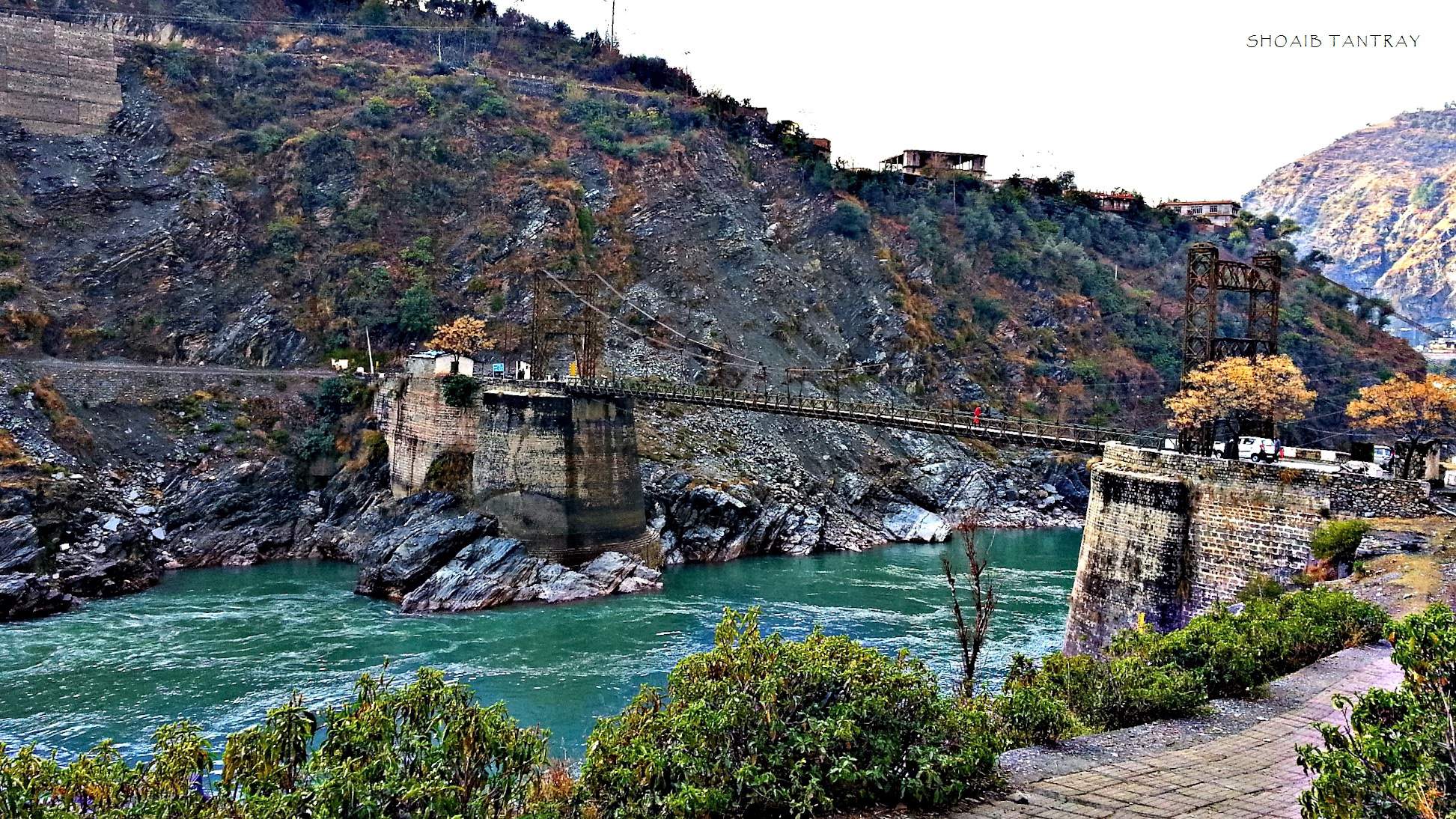
(Image by Shoaib Tantray)
However, the bridge had design
issues related to load-bearing and vibrations. Thus, the motor-bound travellers
had to get down and cross the bridge on foot. Vehicles would then slowly crawl
across, take the passengers on board and then move on towards Jammu or
Srinagar, as the case might have been. Light vehicles, however, could cross
with passengers seated inside. There were, though, not many light vehicles
around. Maharaja Pratap Singh, during whose reign the bridge had been
completed, was the first person to cross the bridge while being seated inside his
car. That was on 02 May 1921, coinciding with the annual Darbar move from Jammu
to Srinagar that year. The whole of BC Road was also thrown open to public on
that date.
An RCC bridge was built next to
the old bridge, a bit upstream, during 1960s. However, many defence officers
and soldiers would remember crossing the old bridge, on foot even till 2004, since
the Transit Camp where the convoys would halt for meal/stay, was located next
to the old bridge. The old bridge was declared unsafe in 2004.
For more interesting stories, follow me here.... Twitter , Facebook or write in ajaykrraina@gmail.com
very informative
ReplyDeleteThanks a ton
DeleteExcellent historical narrative
ReplyDelete